Ramayan (1987) — Review, Story, Cast & Where to Watch

Ramayan (1987) is the timeless epic as India first watched it together, and it remains the most beloved telling of the Ramayana ever made for television. When it first aired on DD National in 1987, from Sagar Arts, created, written and directed by Ramanand Sagar, it became a national ritual: streets emptied, families gathered, and a whole country watched one story on Sunday mornings. Over 78 episodes, ending in July 1988, it followed Prince Ram, the embodiment of duty and honour, through fourteen years of exile, the abduction of Sita, and a war waged not for a kingdom but for righteousness itself. This article tells the full story of Ramayan (1987), introduces the cast, explores its themes, and gives an honest review. It also explains where to watch the show legally.
- Title: Ramayan
- Year: 1987
- Channel / Studio: DD National — Sagar Arts (Sagar Pictures Entertainment); created, written and directed by Ramanand Sagar
- Genre: Mythological drama
- Episodes: 78 episodes (ended 31 July 1988)
The Story of Ramayan
The timeless epic as India first watched it together: Prince Ram, the embodiment of duty and honour, is sent into fourteen years of exile just as he is to be crowned. The exile is the epic's great turning point: Ram, the ideal prince, gives up the throne he was born to inherit because his father made a promise, and his obedience to that promise defines everything that follows. He does not protest or resist; he accepts exile as his dharma, and his quiet acceptance is the first lesson the epic teaches, a lesson about keeping one's word no matter what it costs, even when the price is everything you hold most dear.
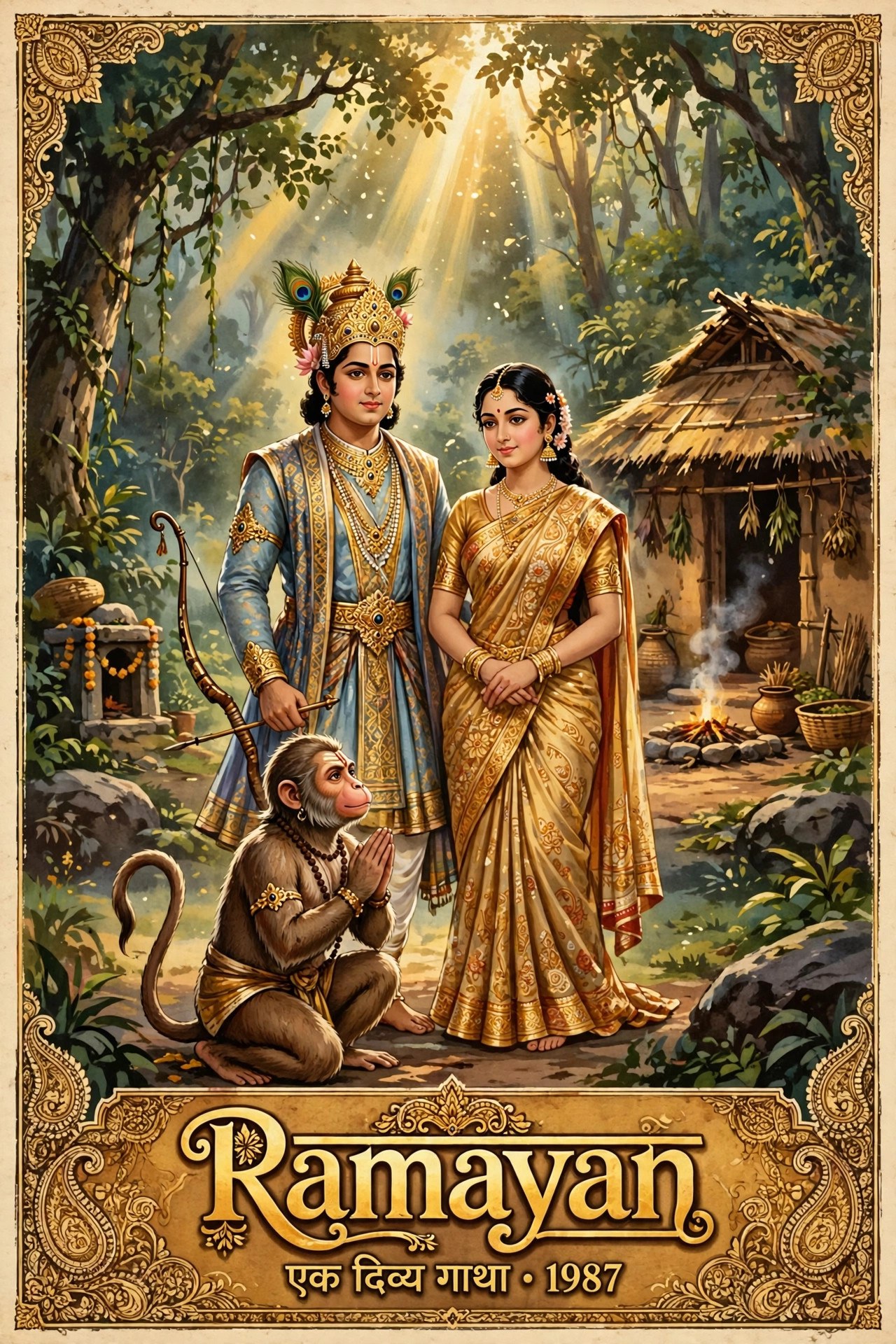
With his devoted wife Sita and loyal brother Lakshman, he journeys into the forest, where the demon king Ravana abducts Sita and carries her to Lanka. The forest years are both an idyll and a test: Ram, Sita and Lakshman live simply and happily, until Ravana's desire for Sita shatters their peace. The abduction is the epic's great crime, and Sita's captivity in Lanka becomes a test of her faithfulness, her courage and her dignity, as she refuses Ravana's advances and holds on to her hope that Ram will come for her, whatever the cost.
With the help of Hanuman and the Vanara army, Ram wages a war not for a kingdom but for righteousness itself. Hanuman's devotion, his leap across the ocean and his burning of Lanka are among the most beloved moments in Indian storytelling, and the war that follows is fought not for territory but for dharma. The battle with Ravana is the climax of the epic, a confrontation between righteousness and pride that ends with Ravana's defeat and Sita's rescue, and Ram's return to Ayodhya after fourteen years is celebrated as the homecoming of dharma itself, a moment of joy after years of sorrow, sacrifice, waiting and faith. First aired on Sunday mornings, the series became a national ritual, streets emptied, families gathered, and a whole country watched one story, and it remains the most beloved telling of the Ramayana ever made for television.
Who Stars in Ramayan
Arun Govil plays Ram, and his performance defined the character for a generation. Ram is the embodiment of duty and honour, and Arun Govil gives him a calm, gentle authority that made millions of viewers see him as Ram himself. His best scenes are the quiet ones: Ram's acceptance of exile, his grief at Sita's abduction, and his steady resolve in war, all played with a stillness that feels divine. His portrayal remains the benchmark against which every later Ram is measured.
Deepika Chikhlia plays Sita, the devoted wife whose faithfulness and dignity carry the epic's emotional heart. Sita is gentle, strong and unwavering, and Deepika Chikhlia gives her a grace that makes her captivity in Lanka genuinely moving and her faith in Ram completely believable. Sunil Lahri plays Lakshman, the loyal brother whose devotion to Ram never wavers, and whose service to his brother is the epic's great example of brotherly love and selfless duty, without expecting anything in return.
Arvind Trivedi plays Ravana, the demon king whose pride and desire drive the epic's conflict. Ravana is powerful, learned and fatally proud, and Arvind Trivedi gives him a menace that makes him a worthy adversary for Ram, a villain whose learning makes his fall all the more tragic. Dara Singh plays Hanuman, the devoted servant whose strength, humility and love for Ram made him one of the most beloved characters on Indian television, and whose leap across the ocean remains an iconic moment that viewers still remember with joy.
Themes and What Makes Ramayan Work
The show's central theme is dharma, duty and righteousness. Ram's acceptance of exile, his war for Sita and his refusal to compromise with evil are all expressions of a single idea: that doing what is right matters more than comfort, power or even happiness. The epic treats dharma not as an abstraction but as a lived choice, made again and again by characters who could easily choose otherwise.
A second theme is devotion and loyalty. Sita's faithfulness in captivity, Lakshman's service to his brother, and Hanuman's devotion to Ram are all expressions of love as service, and the show argues that devotion is the highest form of love. There is also a theme of good against evil, played out in its purest form, as Ram's righteousness meets Ravana's pride, and a theme of family, since the epic is ultimately a story about brothers, wives and fathers, and the bonds that hold them together.
Ramayan (1987) will appeal to every viewer who loves the Ramayana, to families who want to share the epic with their children, and to anyone who wants to understand why this telling became a national ritual. It suits viewers of all ages, and it remains the definitive television Ramayana. Those who prefer modern production values may find its 1980s style dated, but for its audience the simplicity is part of its power, and its sincerity is unmatched.
Our Review of Ramayan
Ramayan (1987) works because it treats the epic with complete sincerity. The writing, direction and performances are all devoted to a single purpose: telling the story as faithfully and lovingly as possible, and Arun Govil's Ram and Deepika Chikhlia's Sita became the faces of the epic for a generation. The show's simplicity is its strength: it does not distract from the story with spectacle, and its emotional moments, Ram's exile, Sita's captivity, Hanuman's devotion, land with a power that modern productions rarely match.
The weaknesses are those of its time. The production values are modest by modern standards, with simple sets and effects, and the pace is gentle, reflecting the Sunday-morning ritual it was made for. Viewers used to fast, cinematic mythological drama may find it slow, though its fans would argue that the slowness is reverence, and that the story deserves to be savoured rather than rushed.
Even so, the verdict is clear. Ramayan (1987) is not just a television show but a cultural landmark, a telling of the epic that a whole country watched together. It remains the most beloved Ramayana on television, and it deserves to be watched by every generation, again and again, with the same love it first inspired.
How to Watch Ramayan Legally
Ramayan (1987) aired on DD National and is available to watch legally on YouTube, where the complete series can be found on the official channel. Because the show ended in July 1988 after 78 episodes, viewers can now watch the whole story from beginning to end without waiting for new episodes, which makes it a good choice for a meaningful family binge. Start from the first episode to see Ram's crowning and his exile, then follow his journey through the forest, Sita's abduction and the great war with Ravana, watching in order so the epic unfolds as it was meant to. Watching through official sources gives the best quality and reliable episode order. Avoid unofficial uploads, which are often incomplete, poor quality or removed without warning.
More about Ramayan: cast, story, official trailer & where to watch »